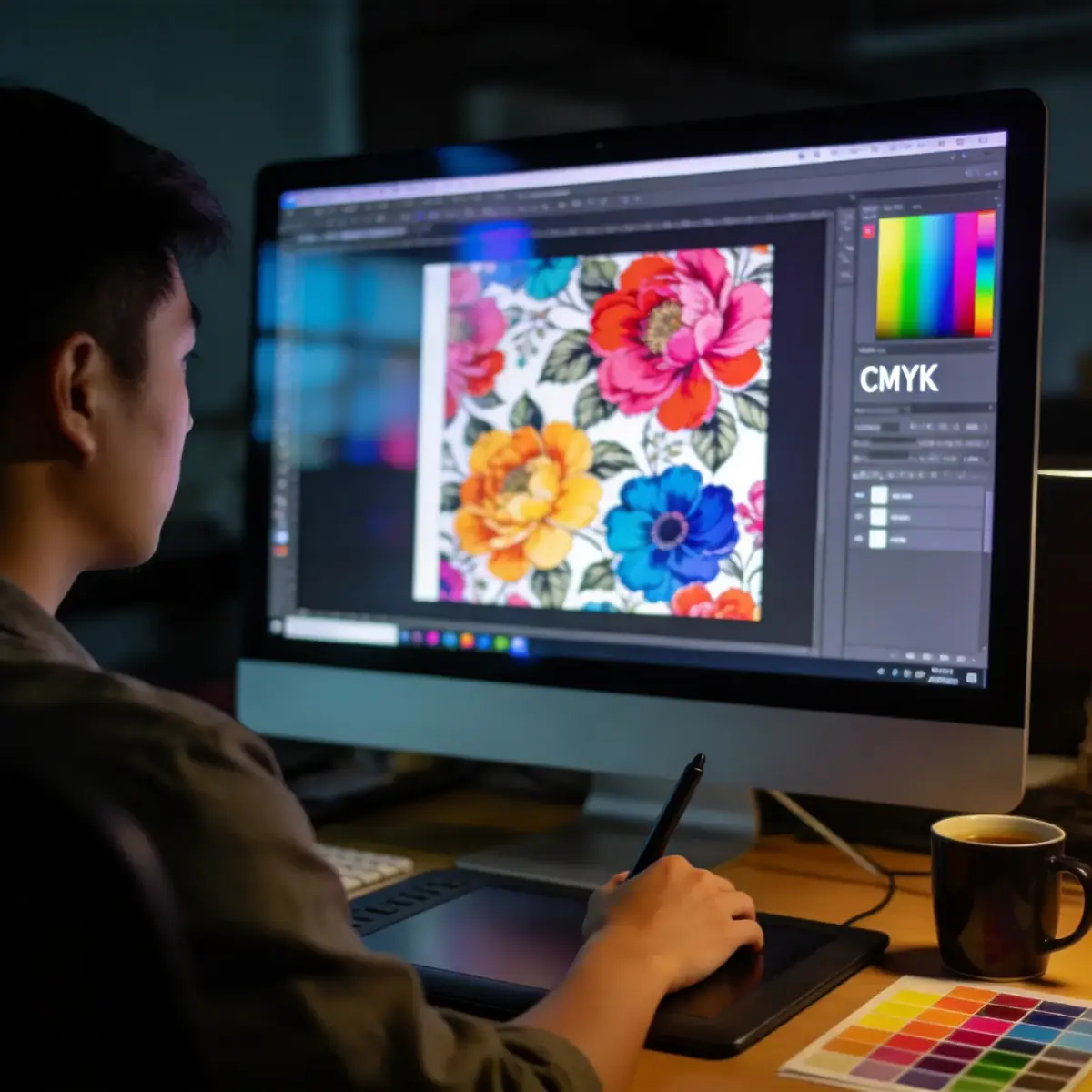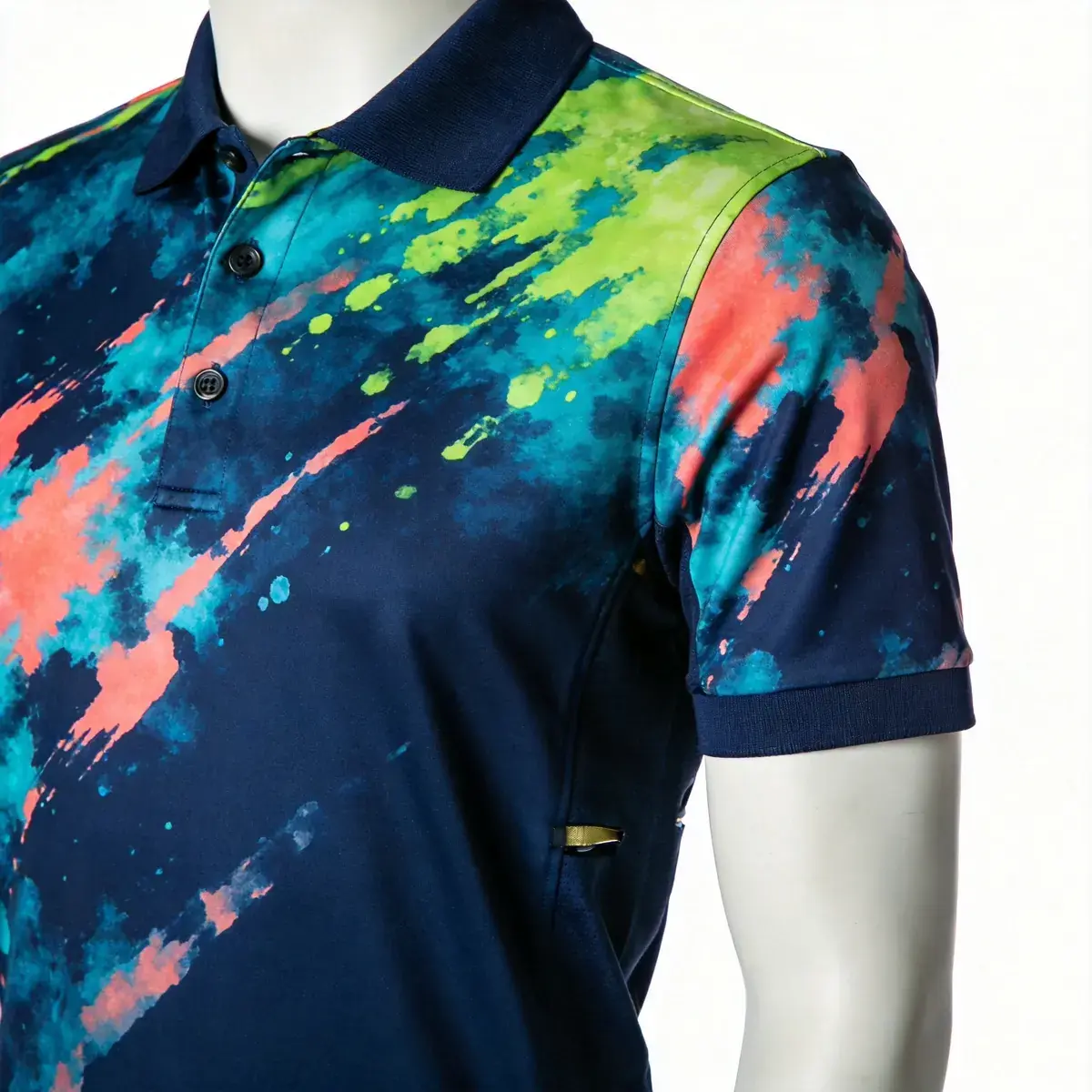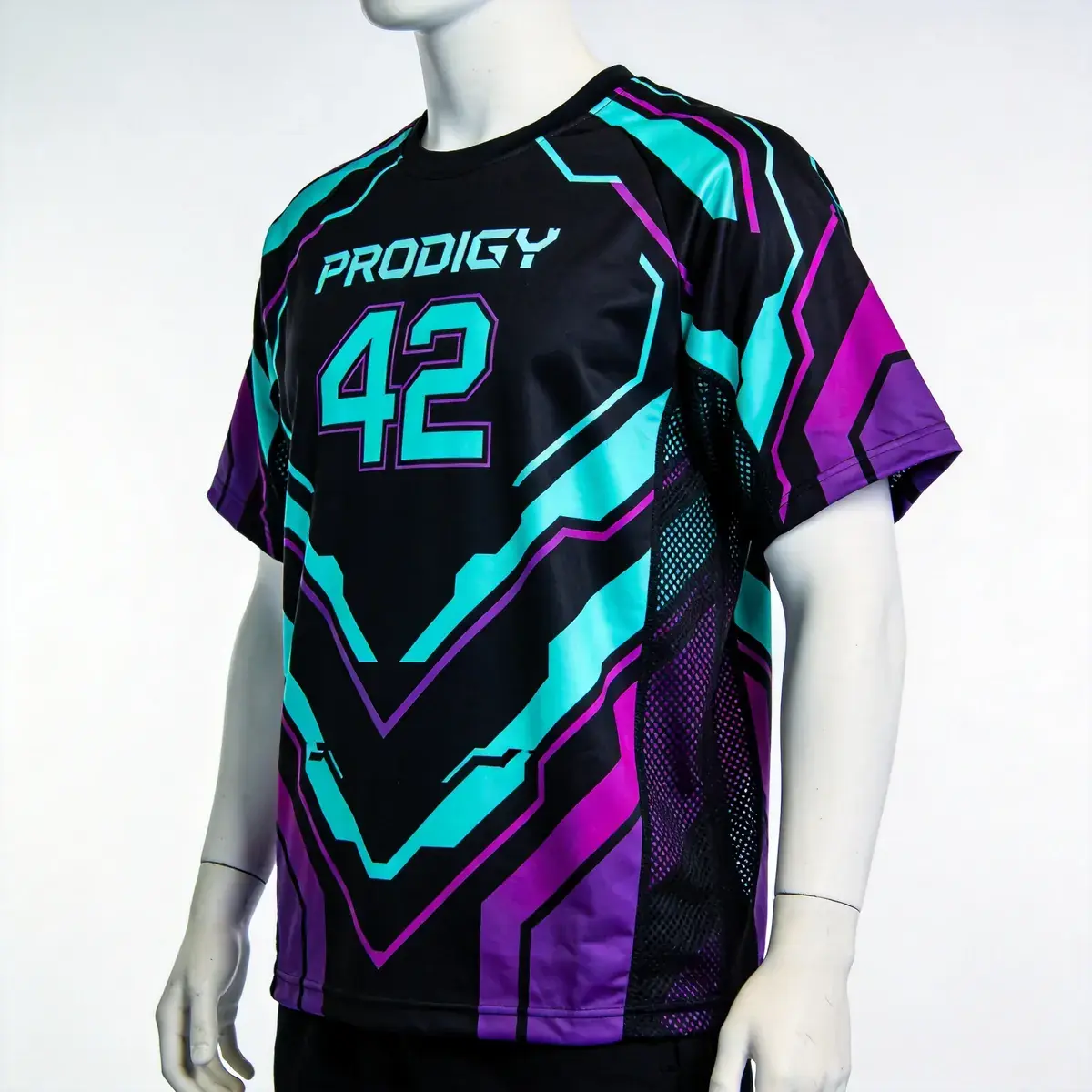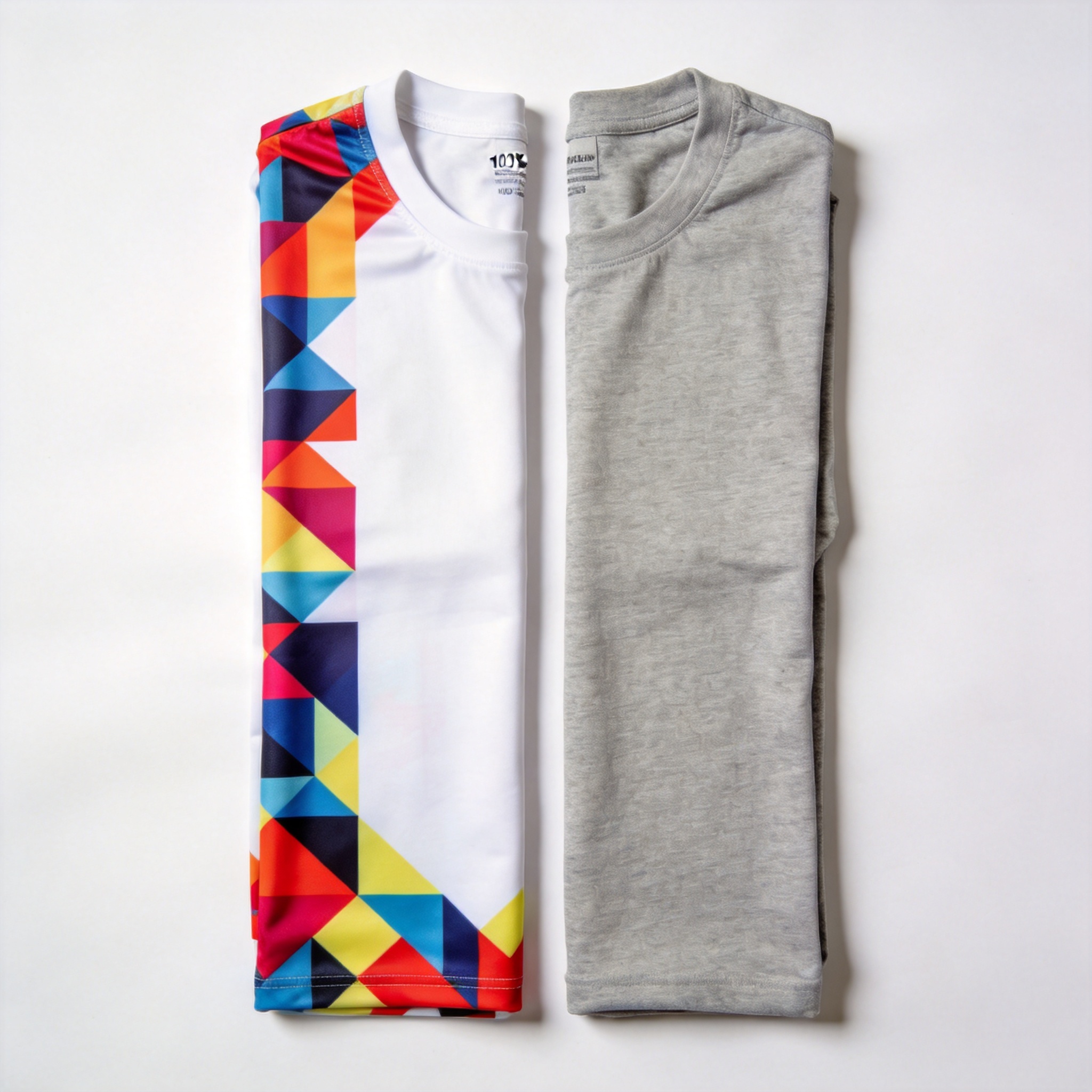
This is the most common question we get from new B2B clients: can we sublimate on cotton? The short answer is no. The longer answer is: here is what cotton does instead, here is what polyester does, and here is what to order when your design brief says 100% cotton but you really want an all-over print.
We run both polyester and cotton apparel in our Yiwu factory every week. This comparison is from production data, not marketing copy — including the actual wash-test results from our QC lab.
01.The One-Sentence Answer
Polyester is the only fabric that bonds with sublimation ink at the molecular level. Cotton does not. If you want a true all-over print that lasts 50+ washes, you need polyester (or a 65%+ polyester blend). If you are willing to accept a smaller print area and slightly different feel, DTG and DTF are the cotton-compatible alternatives.
That is the whole story. The rest of this post explains why polyester wins on print, why cotton wins on comfort, and what to actually do for common B2B use cases.
02.How Polyester and Cotton Behave Under Sublimation
Polyester is a synthetic polymer. Under heat (around 180-200°C), the polymer chains open up enough for dye gas to slip between them. When the fabric cools, the chains close and lock the dye in. The result: the print is part of the fiber. It cannot peel, crack, or fade for the life of the garment.
Cotton is a natural cellulose fiber. There is no polymer structure to open under heat. When sublimation ink is applied to cotton, it sits on the surface of the fiber and then washes out. After 5-10 wash cycles, a sublimated cotton garment is essentially blank.
This is not a manufacturing issue or a cost issue. It is chemistry. No amount of pre-treatment, post-treatment, or different ink will make cotton accept sublimation dye the way polyester does.
03.Print Quality: Polyester vs Cotton Side by Side
On 100% polyester interlock at 180 GSM, sublimation produces: bright, saturated colors that match the design file within 90-95%; smooth gradients with no banding; sharp text down to 6pt at 1:1 print scale; full edge-to-edge coverage with no print area limit. After 50 wash cycles, the print is visually identical to day one.
On 100% cotton at 180 GSM with sublimation attempted, you get: faded, washed-out colors that look 30-50% lighter than the design file; visible banding on gradients; sharp text below 12pt starts to bleed; the print area is limited because the dye does not transfer well past 30x40 cm on most cotton weaves. After 5-10 washes, most of the print is gone.
The same cotton garment, decorated with DTG instead of sublimation, looks much closer to the polyester sublimation result on day one — bright, detailed, and accurate. After 30-50 washes, the DTG print still looks good but the hand-feel (the texture of the print on the fabric) is noticeably different from unprinted cotton. There is a thin ink layer sitting on the surface.
04.Hand-Feel and Comfort
Polyester: smoother, slightly slicker, lighter for the same GSM. Modern moisture-wicking polyesters (especially birdseye and pique knits) breathe well and pull sweat away from the skin. They are the standard for performance apparel — running singlets, cycling jerseys, esports jerseys. The downside: some people find polyester less comfortable in dry, hot conditions because it does not absorb moisture the way cotton does.
Cotton: soft, breathable, absorbent, familiar. Cotton is the comfort benchmark. It is what most end customers are used to wearing as everyday apparel. The downside for performance: cotton absorbs sweat, gets heavy when wet, and dries slowly. Cotton is also the heavier fabric for the same warmth level — a 200 GSM cotton t-shirt is heavier and warmer than a 200 GSM polyester t-shirt.
Poly-cotton blends (65% poly / 35% cotton) try to bridge the gap. The poly accepts the sublimation dye; the cotton adds softness. Trade-off: the print on the cotton portion looks faded compared to the poly portion, so designs with large color blocks look uneven.
05.Cost: Polyester vs Cotton for a 500-Piece Order
For a 500-piece order of 180 GSM t-shirts, the fabric cost difference is small. Polyester interlock is around $2.20-2.80 per garment. Cotton jersey is around $2.40-3.00 per garment. Cotton is slightly more expensive at the same weight, but pricing varies by season and cotton market.
The decoration cost is where the gap opens up. Sublimation on polyester is included in the all-over print price — no extra charge for the print. Sublimation attempted on cotton is not possible, so the decoration alternatives (DTG, DTF, screen print) are quoted separately.
DTG on cotton for a 500-piece run: roughly $1.50-2.50 per garment for a chest-area print. DTF on cotton for the same: $1.00-1.80 per garment. Screen print on cotton: $0.80-1.50 per garment for 1-2 color prints. For full-coverage designs, DTG and DTF are the only realistic options on cotton, and they are noticeably more expensive than sublimation on poly.
Our pricing guide has a full breakdown of decoration costs by technique, fabric, and quantity.
06.When to Use Polyester (Sublimation)
Use polyester sublimation when: (1) you want an all-over print with edge-to-edge artwork, (2) the design has gradients, photo-realistic elements, or more than 6 colors, (3) the garment will see heavy washing (sports, workwear, events), (4) the end use is performance apparel — running, cycling, triathlon, esports, (5) you want the lowest cost per wear over the life of the garment.
Polyester is the right call for about 80% of the sublimation work we do.
07.When to Use Cotton (DTG or DTF Instead)
Use cotton with DTG or DTF when: (1) the customer specifically asks for 100% cotton (some markets — EU lifestyle, premium streetwear, certain corporate buyers — insist on cotton), (2) the design is a small chest-area print (DTG and DTF handle small areas well, and screen print is even cheaper for 1-2 color chest prints), (3) the print is not required to survive 50+ washes, (4) the end use is lifestyle or fashion, not performance.
Note that even on cotton, DTF transfers give you a near-full-coverage print — close to sublimation visually — with the trade-off of a slightly thicker hand-feel and lower long-term wash durability. DTG gives the softest hand-feel but is limited to a smaller print area than sublimation.
08.The Best of Both: Poly-Cotton Blends and What They Print Like
65/35 poly-cotton and 50/50 poly-cotton blends are the compromise fabric. The polyester accepts sublimation dye; the cotton adds softness. The result is a print that looks slightly faded compared to 100% poly, with a hand-feel that is closer to cotton.
We see poly-cotton used for: corporate uniforms where the buyer wants a softer feel than pure poly, school uniforms where cotton comfort matters, and lifestyle apparel where the print is not the main feature.
If you want the print to be the main feature, stick with 100% poly. If you want comfort and the print is secondary, a blend is a reasonable choice. Our poly-cotton fabric page has GSM options and sample ordering.
?Frequently Asked Questions
Can you sublimate on cotton?
No. Sublimation dye only bonds with polyester (and polyester-rich blends above 65%). For 100% cotton apparel with full-color designs, we use DTF (Direct-to-Film) transfers at our factory. DTF is the cotton-friendly alternative to sublimation — it works on any fabric, including cotton, blends, nylon, and even leather.
Which is cheaper, polyester or cotton sublimation?
Polyester is significantly cheaper for sublimation because it is the substrate itself — the dye bonds directly into the fabric, no extra transfer step required. Cotton sublimation requires DTF or DTG (a separate transfer process) which adds film, adhesive powder, and labor. For 500 custom t-shirts, expect polyester sublimation to be 30-50% cheaper per piece than cotton DTF.
Is cotton sublimation as durable as polyester sublimation?
Cotton sublimation is less durable than polyester sublimation. Polyester sublimation bonds the dye with the fiber, so it cannot peel, crack, or fade for the life of the garment. Cotton sublimation (DTF/DTG) sits on top of the fabric as a thin ink or adhesive layer, which can crack or peel at the edges after 50+ heavy washes. For a uniform that needs to last 5+ years, polyester sublimation is the better choice.
What is the best fabric blend for sublimation?
The best blend for sublimation is 90/10 or 80/20 polyester-spandex. The polyester provides the surface for the dye to bond, and the spandex adds 4-way stretch for athletic fit. Cotton-poly blends (50/50, 65/35) can be sublimated but the colors will look muted or washed-out because cotton does not bond with the dye — we generally do not recommend them for vibrant full-color artwork.
Is polyester bad for your skin?
Modern performance polyester is safe and widely used in athletic, medical, and everyday apparel. The 'polyester is uncomfortable' reputation comes from cheap, low-quality polyester used in fast fashion in the 1970s-90s. Today's polyester knit fabrics (especially bird-eye mesh and brushed polyester) are breathable, moisture-wicking, and softer than many natural fibers. For sensitive skin, look for higher GSM and brushed-finish polyester.
Ready to start?
Get a custom quote in 24 hours.
Send us your design, quantity, and deadline. We will recommend the right technique and provide a transparent DDP quote including shipping to your door.
Get a Free Quote